
What a Mill Certificate Tells You
A mill certificate verifies the grade, chemistry and mechanical properties of a heat of stainless steel. Learn what matters for 304 and 316 before fabrication.
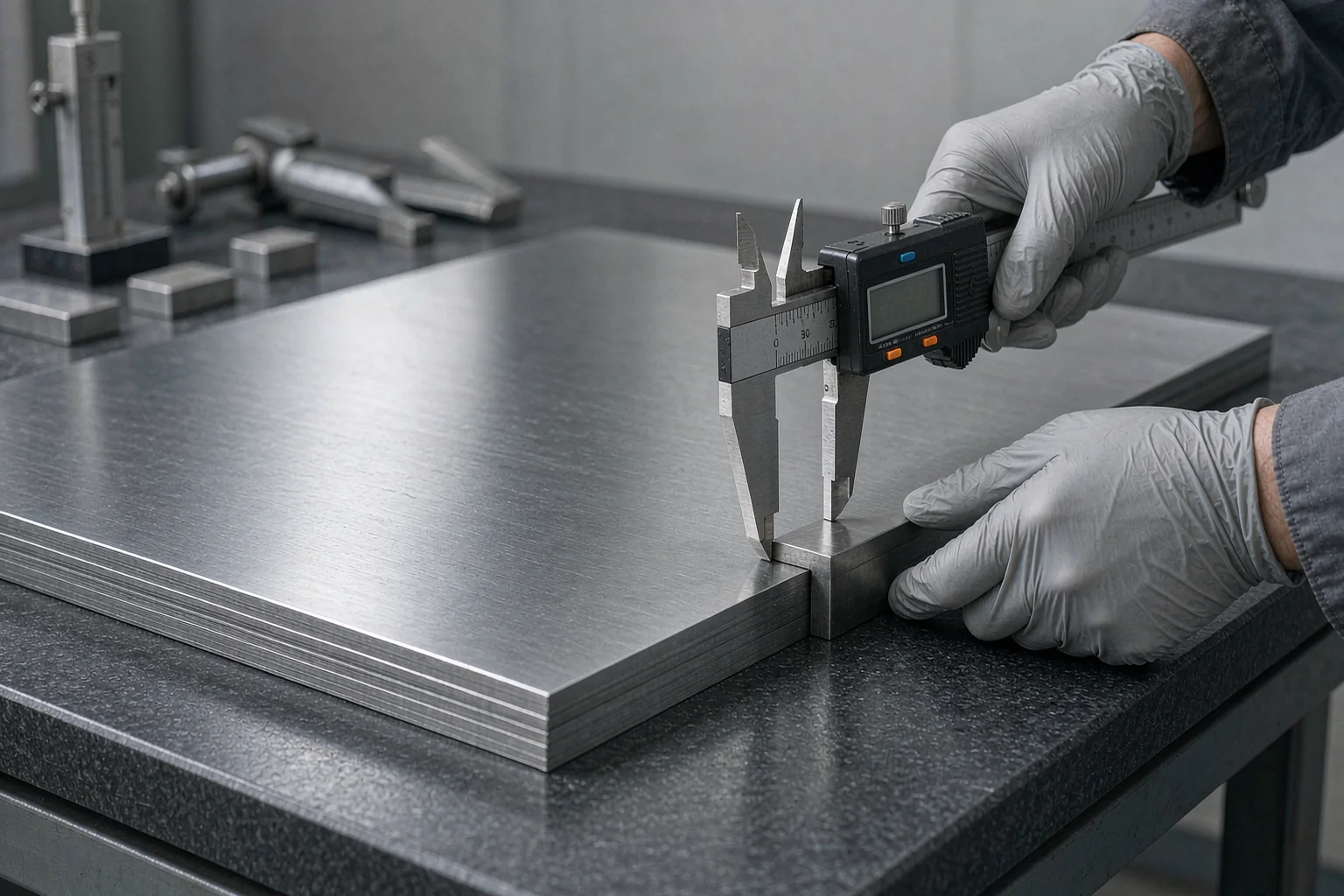
What the certificate actually certifies
A mill certificate, often called an EN 10204 3.1 certificate or a mill test report, is the steel producer's written record of the heat of steel used for your sheet or coil. It is not a product warranty and it is not a fabricator's quality plan. What it tells you is that a specific batch was sampled and tested, and that the results met the standard for the grade claimed. For stainless fabrication buyers, the fields that matter are the grade designation (304, 316, 201 and so on), the chemical composition, especially chromium, nickel and molybdenum, and the mechanical results such as yield strength, tensile strength and elongation. A 316 certificate should show molybdenum, typically around two to three percent, which is the element that gives 316 its better resistance to chlorides. Ask for the certificate to reference the heat or batch number so you can tie the paper to the actual material delivered.
Reading chemistry and mechanical fields
Start with the grade and the standard quoted on the certificate, such as ASTM A240 or EN 10088 for flat stainless products. Then read the chemistry column. For 304 you expect roughly eighteen percent chromium and eight percent nickel; for 316, the molybdenum content is the giveaway. Carbon is kept low, often below 0.08 percent and lower still in low-carbon grades such as 316L, because high carbon reduces corrosion resistance after welding. On the mechanical side, check that elongation is healthy rather than simply chasing strength; a very hard sheet may form poorly on a brake or through a roll. Compare the reported values with the tolerances the standard allows instead of expecting the exact middle of the range. If a figure sits right at a limit, it is still compliant, but it is worth asking about. Keep the certificate beside your quotation so the finish, thickness and grade you priced are the ones shown on the paper.
Where certificates matter most
In a decorative stainless project, the certificate matters most where material is hidden or hard to replace after installation: back-of-house racks, wet-area linings, cladding substrates and panels that will be bent or welded. A brushed display cabinet on a dry retail floor is lower risk, while a rack or screen in a humid coastal city is higher risk, and the difference between 201 and 304 becomes real money over the life of the installation. If your drawings call for 304 or 316, make sure the certificate matches before cutting begins, because mixing grades within one visible run can lead to different tones after finishing and, in humid air, to rust stains. For coloured or PVD-coated sheets, the certificate covers the base steel rather than the coating, so request coating information separately. We supply display cabinets, screens, coloured sheets, racks, aluminium carvings and bent parts to drawing, and can discuss certificate requirements on WhatsApp +86 17324671020 or by email at chen847415774@gmail.com, with a reply within 24 working hours.
How to request and file them
Ask for the mill certificate at quotation stage and again with each production batch, with the heat number clearly visible. A supplier who can produce it quickly is usually one who tracks material properly. When it arrives, check that the grade and thickness on the certificate match your purchase order, then file it against the project reference together with your drawings and packing list. If you work through a fabricator, confirm that the certificate covers the material actually used rather than a generic sheet from stock. Note that a certificate describes chemistry and mechanical properties; it does not describe surface finish, colour or dimensional tolerance, so those belong on the drawing or specification sheet. Keeping all three documents together makes disputes easier to resolve when a panel arrives scratched or a colour looks different from the approved sample.
Factory and project images are AI-generated illustrations, not photographs of a real facility or completed project.
Have a drawing ready?
Send it on WhatsApp or by email. Get grade, finish, MOQ and lead time back within 24 working hours.