
Designing a Stainless Jewelry Counter
A jewelry counter must protect pieces and make them look valuable. Learn how grade, mirror finish, lighting and display height work together in retail settings.
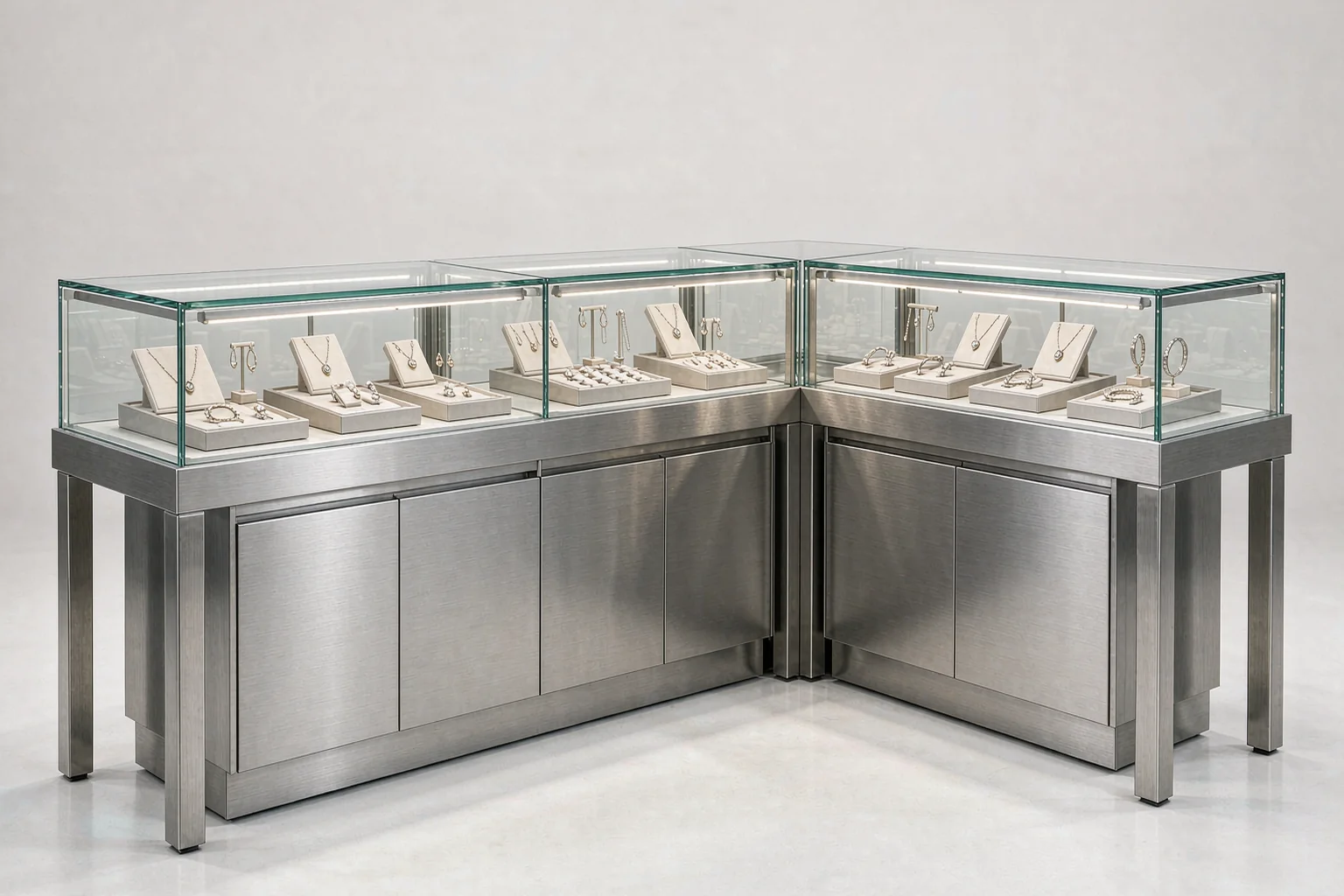
Why stainless works in a jewelry counter
A jewelry counter has two jobs that pull in different directions: it must protect small, valuable pieces and make them look worth the price. Stainless steel handles both well when the grade and finish are chosen carefully. Grade 304 suits most dry retail interiors, while 316 is safer in coastal or humid locations where chloride in the air can stain a polished surface. The metal itself resists scratches better than plated brass and does not corrode with contact from skin oils. Mirror polish gives the bright, precious look that jewellery retailers prefer, but it shows fingerprints, so many counters use a brushed field with polished edges. A PVD champagne or warm gold finish adds colour without the wear problems of real gold plating. Considering these options early prevents a counter that looks impressive on day one and tired after a month.
Layout, height and sightlines
Layout determines whether a counter sells or simply stores. A working height around 900 to 1000 millimetres lets most customers look down comfortably at trays and settings. Glazed display tops should use tempered glass around 8 to 10 millimetres, with the frame designed so reflections do not hide the pieces. Plan tray depth and dividers before fabricating: shallow trays keep rings and earrings visible, while deeper sections suit bracelets. Lighting deserves as much attention as the metal. A colour temperature near 3000 to 4000 kelvin with a high colour rendering index makes gemstones read naturally, and strip lights should be shielded so customers never see bare diodes. Position spotlights at an angle that avoids glare on the mirror surface. A mock-up of one section is often worth more than a full drawing.
Security and practical details
Security and daily handling shape the details of a good counter. Locks should be discreet but reachable, and hinges should be concealed so they cannot be prised open from outside. Drawer runners need to carry the weight of a full tray without sticking, because a jammed drawer during a busy hour is a real problem. Cable management matters too: power for lighting must be routed away from display areas and hidden from view. Base cabinets should allow staff to reach cleaning cloths and spare trays without opening the customer-facing side. Where several counters stand together, align the seams and the PVD colour across units so the run reads as one piece. Ask the supplier which lock hardware and glass thickness they propose, and whether the finish is applied before or after assembly. Our team can review drawings for custom display cabinets through WhatsApp at +86 17324671020 or email chen847415774@gmail.com, with replies within 24 working hours.
Specifying the counter for a fit-out
Specifying a counter for a fit-out is easier when you separate appearance from structure. Give the supplier overall dimensions, the grade and thickness of the stainless, the finish reference and the glass specification. State the target colour temperature for lighting and whether the power supply sits inside the base. Request a sample tile of the finish and approve it under the same lighting used in the store, because a warm showroom can change how a champagne PVD looks. For a run of several counters, confirm that all units will come from the same coating batch to keep colour consistent. The illustrative image of a finished counter shows a possible arrangement, not a real project. Once the sample and drawing are approved, ask for a written production schedule so installation can be planned around it.
Factory and project images are AI-generated illustrations, not photographs of a real facility or completed project.
Have a drawing ready?
Send it on WhatsApp or by email. Get grade, finish, MOQ and lead time back within 24 working hours.