
CNC Carved Panels: Aluminum vs Steel
Choosing aluminum or stainless steel for CNC carved panels? Compare machining, weight, durability, finishing and cost to pick the right metal for your project.
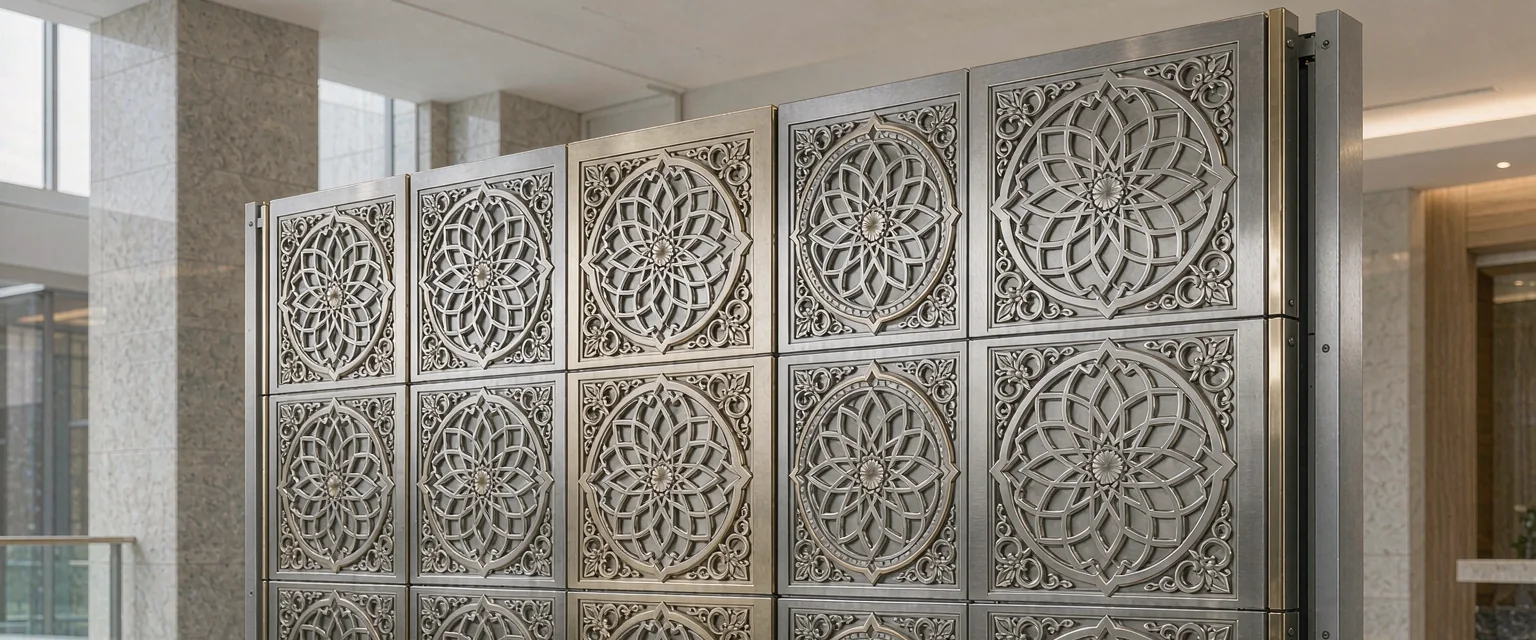
What CNC carving does to metal
CNC carving uses a rotating cutter guided by a digital file to remove material and create relief, engraving or a through-pattern in a flat panel. It is how decorative motifs, logos, lettering and textured surfaces are produced repeatably in metal. The process differs from laser cutting: a laser melts through thin sheet to make flat profiles, while a router or milling spindle cuts and shapes thicker material in three dimensions. For carved panels, the depth of cut, tool diameter and feed speed determine how crisp the detail is. Aluminum and stainless steel are the two common choices, and they behave very differently under the tool. Aluminum machines easily, allowing fast feed rates, deeper passes and intricate detail with less tool wear. Stainless is harder and work-hardens if the tool rubs instead of cutting, so it needs sharp tools, slower speeds and more careful programming. Understanding these differences explains why the same design can cost very differently in the two metals. The design file is the starting point for both, so a clean vector or 3D model matters as much as the material choice.
Aluminum: light, fast and easy to finish
Aluminum is the easier metal to carve. It cuts quickly, generates less heat and puts far less strain on cutting tools, which keeps machining time and tooling cost low. Grades such as 5052 and 6061 are commonly used: 5052 bends and forms well for decorative panels, while 6061 is stronger and machines to a cleaner finish. The metal is about one third the weight of stainless steel, so large panels are easier to handle, ship and mount, and they put less load on fixing systems. Finishing options are broad. Aluminum can be brushed, bead-blasted, anodised in clear or colour, or powder-coated, and CNC carving produces sharp, clean edges. Anodising adds a durable coloured surface without the cost of a PVD coating. The trade-off is hardness: aluminum scratches and dents more easily than stainless, so it is less suitable for high-traffic touch points or exposed outdoor locations where impact is likely. For interior signage, decorative wall panels, ceiling features and lightweight screens, aluminum is often the most practical and economical choice.
Stainless steel: heavier but built to last
Stainless steel is heavier, harder and more demanding to machine, but it rewards the effort with strength and longevity. Grade 304 is the standard choice, with 316 reserved for coastal or high-humidity sites. Carving stainless requires rigid setups, sharp carbide tools, slower feed rates and good cooling, because the metal work-hardens when a tool rubs and can quickly dull a cutter. That makes machining slower and more expensive than aluminum. What you get in return is a panel that resists scratches, dents and corrosion, and keeps its appearance in busy public areas. Stainless also takes a PVD coating exceptionally well, so carved panels can be finished in gold, rose gold, black or champagne for luxury retail and hospitality. Cut edges should be deburred and, where the panel is outdoors or near the coast, the same grade should be used throughout the assembly. For a feature wall in a hotel lobby, a lift interior or a high-end shopfront, the durability and premium finish of carved stainless justify the higher cost.
Choosing the right metal for your panel
Base the decision on where the panel will live and how it will be finished. For an indoor decorative panel, signage or a ceiling feature where weight and cost matter, aluminum is usually the better fit, especially when an anodised colour is acceptable. For a high-touch area, a coastal location or a project that calls for a PVD colour, stainless steel is worth the extra investment. Consider the panel size too: very large carved panels favour aluminum because the lower weight simplifies transport and installation, while smaller, highly detailed pieces are economical in either metal. Ask your supplier for a sample of the carved texture and the proposed finish, and confirm the tooling approach so the detail comes out clean. Provide a vector or 3D file, the panel dimensions, thickness and finish, and request a written note on tolerances and lead time. We produce carved panels, screens, colored sheets and bent metalwork to your drawings and reply within 24 working hours. Send your design on WhatsApp at +86 17324671020 or email chen847415774@gmail.com.
Factory and project images are AI-generated illustrations, not photographs of a real facility or completed project.
Have a drawing ready?
Send it on WhatsApp or by email. Get grade, finish, MOQ and lead time back within 24 working hours.